Posted on

The road less travelled: Real conversations

The Conversation: The Spaces Between, 2020.
Oil on canvas, 32×34.5cms.

I started The Conversation series in 2019 during the tumultuous time of Brexit and the Hong Kong protests. Perhaps it was circumstantial, but somehow it felt as if divisive forces had infiltrated my daily life. I felt on edge, worried about saying something that might insult someone or initiate an unintended heated debate. I often felt my opinions were inaccurately categorised and misunderstood. I worried about friendship and familial bonds cracking: I suspect many people felt the same.

Under these circumstances, I thought a lot about and began to solidify values of democratic governance, intellectual freedom, and moral equality in my mind. As an artist in the democratic world, I had assumed that my freedom of expression would continue to be a given. I would still like to assume as much, but lately it hasn’t felt that way.

Imagine my shock in reading about the Royal Academy’s action for pulling Jess de Wahl’s work from their shop. Here was an established and well regarded institution in the democratic West that I had admired and supported whilst living in London, seemingly unable to find a way to support multiple points of views. But even more shocking to me was the response of the students of the Royal Academy.

I struggled to rationalise the fallout from this expression of opinion and hoped that the Royal Academy would find a way to navigate this issue without setting the example that incompatible points of view would not be tolerated.

Having studied and practiced as an Art Psychotherapist, I began to observe the patterns of these types of disputes in conversations and tried to find ways to visually represent them. I really wanted to find a way to make them beautiful as a reminder that the goal of expressing different opinions, in my mind, should always be to listen and find a constructive resolution.

The Conversation: The Spaces Between, 2020 is available for sale through my website and can be viewed at Atelier do Tijolo.

Posted on

The journey vs. The destination

Paphiopedilum II-I, 2023.
Ink On Paper, 17.78 x 12.5cm.

My approach towards painting, and probably most things in life, is to focus on the journey rather than the destination. I find the twists and turns that crop up when one is open to them, far more interesting and challenging than a straight line of A to B.

My Paphiopedilum series is one of those journeys. When I began the series, I had been given a Paphiopedilum as a thank you gift. I was attracted to the showy yet delicate flower and as artists often do when something catches their interest, began to draw, paint and read about them.

First I learned about orchids more generally, by reading Simon & Schuster’s Guide to Orchids. Their bright green, fleshy, finger-like roots were weirdly beautiful to me, but what really captured my interest was the annual single bloom hybrid Paphiopedilums.

I came across The Scent of Scandal: Greed, Betrayal and the World’s Most Beautiful Orchid, by Craig Pittman. I found the human desire for uniquely beautiful flowers fascinating.

While I read and learned about my orchid, it bloomed and began to show signs of wither. I realised I didn’t have much time left so I drew and painted it to have a memory of it. When it fell, the beauty of its decay was exquisite to me and I photographed it obsessively to try and capture the luminous and veined petals.

Eventually I thought to make a print from it. Because of its delicate nature at that stage, I was only able to make one. I loved the idea that in making this print, it had actually taken me the best part of a year growing it to the point at which I captured its likeness. It was a journey, only known to me, that would be memorialised in a single moment.

A year, and a lot of doubt later, a second bloom arrived. Paphiopedilum II-I, 2023 is available for sale through my website and can be viewed at Atelier do Tijolo.

Posted on

Points of departure: Time and fantasy

Abstract Fantasy Landscape study II, 2021.
Oil on canvas board, 10×7.5cms.

At the time of painting the Abstract Fantasy Landscapes series, we were still in the midst of intermittent bursts of Covid lockdowns. I really wanted to get outside to paint, but with the various restrictions this wasn’t something I could do easily. As a substitute I began to paint from photos.

I was using photos from a magical trip I had taken to Madeira. The scenes I was choosing were the same scenes that had originally captured the photographer in me. I realised that I was not able to separate my trained photographer’s eye and wanted to capture every small detail accurately (read: photographically). The early paintings from this series looked dated and dull in comparison to the photos. They lacked what I already had captured in the photos, and to simply replicate the photograph in paint seemed an exercise in futility. Not a all the feeling I wanted to remember or convey about this place that had so taken my imagination. And so I abandoned this approach.

Going back to the drawing board, I found eight mini canvases that I had begun at least six months earlier, and decided to rework them. They had been small sketches of scenes in the UK that I hadn’t quite managed to find my way back into after letting the first layer dry. Something didn’t quite seem relevant anymore having physically moved away from that environment.

It made sense to me to reuse the existing paintings as a guide to imagine new landscapes in – the new landscapes of my life in Portugal. As such, these miniature paintings are special to me as they hold the time of this special transition in my life within their layers.

Abstract Fantasy Landscape study II, 2021, is available for sale through my website and can be seen at Atelier do Tijolo.

Posted on

Points of departure: The big pause

Calçadinha do Tijolo II, 2021.
Oil on wood board, 61x51cms.

Places have become an important point of departure in my art practice since I moved to Lisbon. Perhaps it is specific to my history of moving countries beginning at 6 months old, but it is a much bigger topic than just my individual experience. Place is important to our sense of home and identity, and in some cases represent ideologies and centuries of conflict. However, this is an ongoing preoccupation that I’m sure I’ll be writing more about in the future, so for now, I will stick to telling the story of this particular place in this post.

Calçadinha do Tijolo II was painted in 2021, shortly after moving into my current atelier space. As a Covid transplant to Lisbon, the city was unusually calm and quiet, and on reflection, self-aware – something I wonder whether I will ever experience again. I wanted to make a painting that memorialised the beginning of my life here.

During the first six months, the atelier had a work desk and chair, a small bookcase, a fridge, sink, a few boxes of my art materials, and my hammock. The rest was a sea of empty space. I utilised it by stapling canvases straight onto the walls and moving from painting to painting according to my mood. I occasionally climbed into my hammock to read a book or contemplate how to best utilise the space. I drew floorplans and learned about the changes in light across the seasons. Slowly I began to add plants, a rug, pillows, and a space heater. As my space changed and filled up with more work, old and new, my view of the outside wasn’t changing at the same rate. The ‘Big Pause’ gave me time, which was comforting and I wanted to remember it.

The name Atelier do Tijolo has been inherited from it’s last occupants, a co-working studio. It is situated within the winding streets of Alfama, one of the oldest areas of Lisbon, halfway between the Tagus River and Castelo de São Jorge. I love the idea of people wandering, getting lost, and happening upon my atelier. The first two years after I officially opened my doors to the public, this certainly seemed the case. I met people from all over the world who wandered in and told me their stories.

The reality, once life regained it’s usual frenetic pace, seems to be that most people, when lost, are really on their way somewhere. Perhaps there isn’t as much time to wander and get lost anymore. Today, outside the atelier, the streets are busier and noisier. The people who do visit me are looking for me through Google. And I’ve been told multiple times, that a) it’s hard to find me, and b) that the space has a stillness and tranquility in contrast to the bustling city outside. Perhaps now outside is changing faster than I am.

Calçadinha do Tijolo II, 2021 is available for sale through my website and can be seen at Atelier do Tijolo.

Posted on

Points of departure: Spaces within

The Time Series: Remembering the Future, 2020.
Oil on wood, 18x24cms.

‘Why do we remember the past and not the future? Do we exist in time or does time exist in us?’ – The Order of Time, Carlo Rovelli.

Up until Covid, I had mostly looked outward for painting inspiration, but the time during lockdown precipitated a period of internal focus. I had been taking a painting class with ESOP, which managed to switch to a Zoom format for the first day that the UK went into lockdown. There was barely any transition time as I seem to remember that that lockdown for the following Monday was announced on the Friday afternoon.

I remember the initial, unknown strangeness of allowing people into what had previously been my own private home studio space. I hadn’t thought about it before the class started, so in the few minutes prior I suddenly panicked as I looked around the room. I hadn’t really realised prior to this moment just how private I was. I suppose this is probably what precipitated my interest in painting spaces during lockdown.

I began with painting views of actual spaces; my bedroom, the stairs, and the Zoom classroom. At first, I found the enforced situation novel and interesting, but eventually I began to find the inability to move frustrating. For me, it wasn’t about being able to go out and about in my daily routine, it was about not being able to move forward. We had decided early in 2019 that we would move to Lisbon, although specific dates hadn’t been decided. I had begun initial research for finding somewhere to live and had found somewhere that we really liked. I began dreaming about the space and tessellating the placement of our furniture within this space that only existed to me online. I began to do this almost religiously, every night before going to sleep.

Remembering the Future, 2020 was a painting from my imagination about the apartment we would be moving to. It came out of a pre-sleep dreaming, of remembering our plans in an uncertain future.

Remembering the Future, 2020, is available for sale through my website and can be seen at Atelier do Tijolo.

Posted on

Points of departure: Chaos and structure

An Imposition on Order and Chaos, 2019.
Oil and acrylic on canvas, 78x93cms.

In February 2019, the Fugitive Offenders and Mutual Legal Assistance in Criminal Matters Legislation (Amendment) Bill was proposed by the Hong Kong government, receiving widespread criticism, leading to the Anti-Extradition Law Amendment Bill Movement. These protests became the marker of several years of change in my life.

Around the same time, I created the Safe installation that featured a black square using Stuart Simple’s Black 2.0. I wanted to evoke both the historical context of Kashmir Malevich’s Black Square painting from 1913 and the more contemporary Anish Kapoor vs. Stuart Semple Vantablack controversy from 2016.

In October 2019, as the Hong Kong situation escalated, I was experiencing a lot of anxiety and concern for friends, family and the general state of the place in which I had called home. I felt helpless and useless watching from afar, unable to think of a way to help or get involved meaningfully.

I had been making studies of the strong, rock-like female figures I had seen at a retrospective of Beatriz González. At the same time, I began painting An Imposition on Order and Chaos, 2019 – gradually morphing from chaotic splatters of discordant colours into solid rock forms. As I delved further into her works and process, her story struck a chord and helped to precipitate the further development of The Black Square series. So, although there is no black square present in this painting, it paved the way for the following works.

An Imposition on Order and Chaos, 2019 is available for sale on my website or through Atelier do Tijolo in Lisbon, Portugal.

Posted on

En plein air in California

California Burning: Reflections in Solitude, 2018.
Oil on canvas board, 23×30.5cms.

Oh the dream of being out in nature, painting beautiful scenery everyday! The reality is often complicated by so many challenges and obstacles that it is more an occasional treat rather than a regular meal.

At the start, all I required was reasonable weather, a sketchbook and some pencils and watercolours. I added to this setup a thin blowup pad to sit on and a flask full of sweet tea. When the cooler weather began to show more challenges, I added to my list thick hiking socks and a wooden throw. With this setup, I frequented the urban parks around London, happily drawing trees and statues for 2-3 hour stretches. Snacks and toilets were easy to come by.

But soon I began to itch for my oil paints and wilder environments.

The first issue was acquiring equipment that I would be able to carry. Having been a photographer for more than a decade, I had plenty of experience of carrying more weight than I could manage. Being of fairly slight stature (163cms and 52kgs) means that I have to be extremely selective of what I take with me on any given outing – and we’re not just talking about the painting equipment but also the supplies to see me through a day of painting. There have been many attempts thwarted and cut short due to being unprepared.

Over the years I slowly researched possible solutions and acquired various tools and bits of gear. In 2018, I decided to return to my California stomping grounds to do a camper van painting trip. Having the camper van meant that I could travel further into ‘the wild’ with my equipment easily. I could take as much of my art supplies as I desired in addition to having hot tea and snacks to hand. It was two weeks of my kind of painting bliss!

Reflections on Solitude, 2018 was painted in the Ojai mountains in California, and is available on my website.

Posted on

Painting Tanja

Tanja, 2018.
Oil on canvas board, 41x33cms.

I like to think that my years in portrait, beauty and fashion photography trained my eyes to study faces, and this in turn has helped my portrait painting. However, before I began to pursue commercial photography training, I remember taking a portrait painting class in college that was a turning point for me.

Prior to that class, my secondary school art teacher had taken one look at my drawings of people, shaken his head and asked me to focus on subjects like bikes. I spent the subsequent year making drawings of bike spokes and generally being quite unhappy. I suspect somewhere along the way, I decided I would prove him wrong. So when I had the freedom to choose my classes in college, I ignored the ‘advanced’ label on the portrait painting class and signed up. The first semester of the class was disastrous. I didn’t have the drawing/observational skills required and I struggled with the basic concepts of light and shadow and using paint. My final naive portraits, though lacking the formal technical skills, were expressive, exciting and even recognisable!

Fast forward to 2018. I wanted to learned how to use oil paints and decided that I would do so by taking evening classes in portrait painting. This time round, I was interested in accurately depicting people. I found the London Atelier of Representational Art that followed the Charles Bargue Drawing Course and did an intensive week of making exact pencil and charcoal copies of Bargue drawings and eventually culminating in charcoal drawings of plaster casts (mine was a foot). This is about the time I discovered that the normal trajectory of learning to draw would’ve been still life > the figure > portrait. But, again, I impatiently jumped ahead and signed up for an advanced portrait painting one day workshop.

I was pretty nervous the morning of the workshop when we began with painting the figure to “warm up” our eye. I had very limited experience drawing, let alone painting, the figure which was shown clearly in high contrast to my fellow students. However, when we moved on to the portrait, I discovered that I was seeing the model, Tanja, through different eyes. My years of adjusting lighting for and photographing faces somehow felt familiar and I was able to focus my attention in a way that I had found difficult for the full figure. And 7 hours later, I left the school carrying this wet portrait home.

Tanja, 2018 is available for sale through my website.

Posted on

Natura morta in Florence

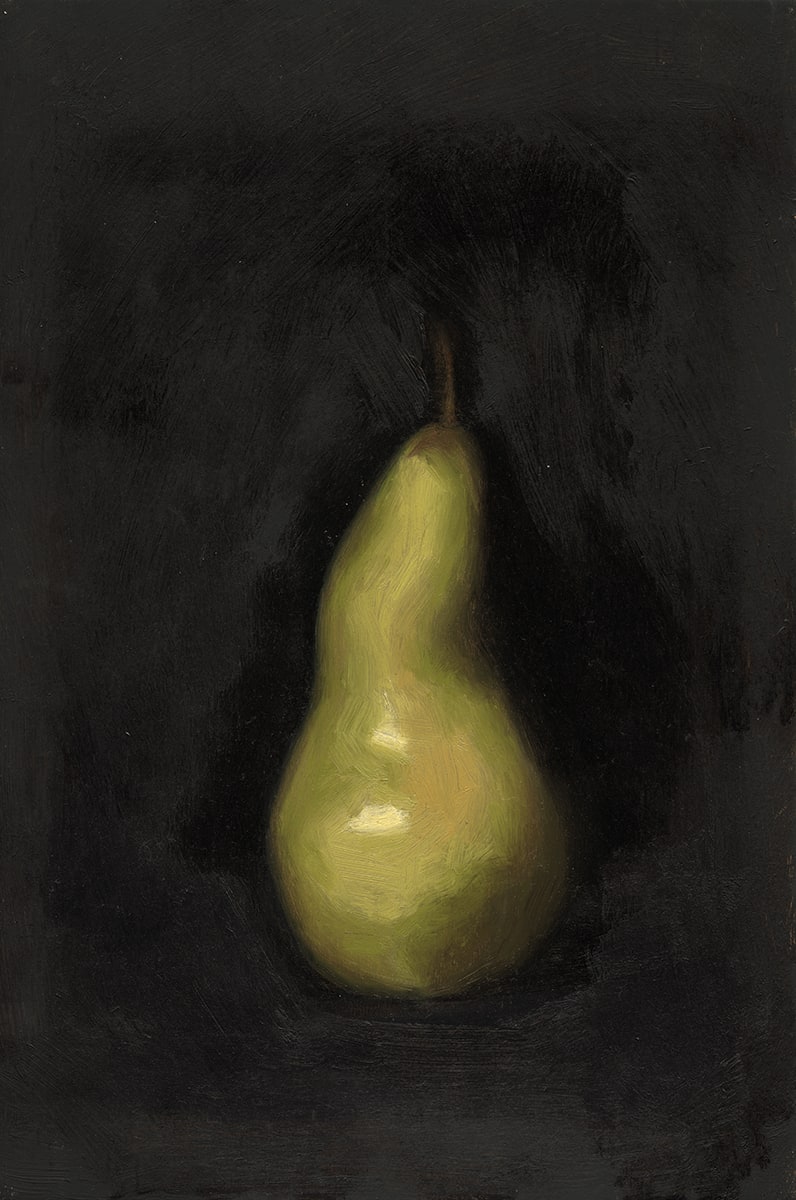
Natura Morta di Pere, 2018.
Oil on wood panel, 30x20cms.

I came to painting from a somewhat unconventional route. I had studied some art history in the past, as a photography student, but I had been mostly interested in contemporary art. As such, my approach to art making was playful and primarily experimented with materials and their qualities.

My interest in painting developed from a desire to “be able to draw properly”. I began by taking evening drawing classes which led me to search for a more traditional approach. I became interested in the skills and knowledge of the Renaissance masters, and decided to explore a more traditional and observation focused route into drawing and painting.

In 2018, I spent six weeks at The Florence Academy of Art, soaking up the likes of Michelangelo, Botticelli, Raphael, Giotto as the backdrop to learning a systematic discipline for painting.

The method was exacting and unforgiving. It required commitment and restraint. I learned how to see, plan and lay paint to mimic the surface contours of fruit, vegetables and skin. I learned to love the more laborious rituals of painting: from observing and working to the light to organising paint systematically on my palette. Natura Morta di Pere is one of my early still life paintings from those wonderful and almost monastic days in Florence still shape my foundations in painting.

Natura Morta di Pere, 2018 is available for purchase.

Posted on

Art as Practice: 100 paintings

From Nothing I-C series, 2021.
Fine art Giclée print on Hahnemühle Photo Rag, 21x30cms.

The global lockdown of 2021 was a perfect opportunity to focus on disciplined practice. Lockdown meant less distractions and having just moved from the UK to Portugal I was ready to start something new. I decided to embark on a project to create 100 paintings. I thought the project would be a good opportunity to explore what it means to have a ‘visual language’.

Having recently discovered Henry Ward’s Shed Paintings I imagined that being unconstrained like this, I would unleash a creative force inside me. Although I did indeed initially feel free, I soon discovered that too much freedom was sometimes overwhelming.

Although project beginnings are exciting, the first challenge is always facing a blank page. Sitting in silence, staring at a blank page, in my equally empty studio I just listened to what was happening in my brain. There was an internal battle between a calm, almost inert force that could sit and wait, and an impatient, impulsive energy that just wanted to burst onto the canvas: part of me wanted order, a systematic approach and another part wanted an experimental, disorganised start. All were subject to my internal critic. These feuding ideas became paralysing, so I began listening to art podcasts to occupy my brain so that my hands could concentrate on painting.

Listening to podcasts worked but I didn’t particularly like the final images I was producing. The voice of my doubtful internal critic grew louder and, once again, the blank page began to feel daunting. Feeling there were too many options, I tried to instigate ‘rules’ such as; 100 paintings in 100 days, no external inspirations, explore the same thing for seven days, let the brushes and paint guide you, only use one tool for an entire painting, choose one colour and make any mark, start with a background, sit still until the inspiration comes, plan ahead. Some of the rules solved problems, others encouraged discipline. But all of them were met with a new and stronger trait: a rebel of all rules, which returned me to the beginning stage of total freedom, and the cycle of my natural process began again.

This project taught me how to recognise and use my various traits to my own artistic advantage. Some are still difficult to manage but the phrase ‘trust the process’ has become a mantra that reminds me that art practice is not just about the final product: its about the internal, psychological struggle that we encounter and have to overcome as part of the process.

From Nothing I-C series, 2021 is available for sale as fine art Giclée prints through my website and the original paintings can be viewed at Atelier do Tijolo.